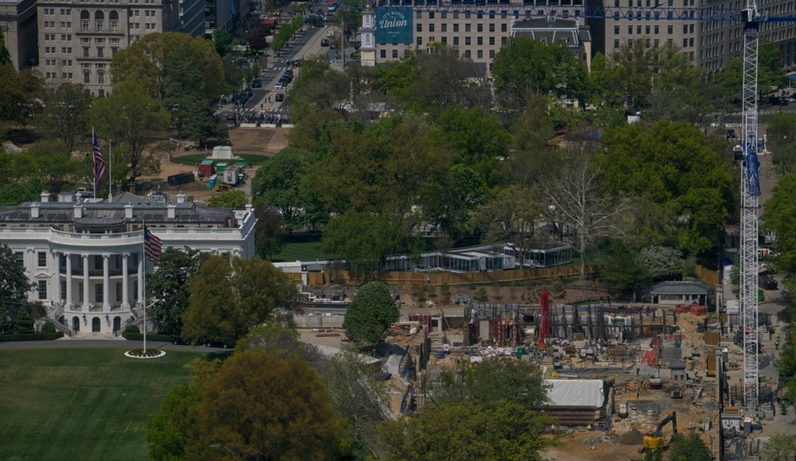
President Donald Trump strongly disagreed with a federal judge’s decision to stop the construction of an above-ground White House ballroom. He said the decision was unfair and politically motivated. The project, which costs $400 million, will build a big ballroom on the White House grounds to take the place of the East Wing, which was torn down not long ago.
U.S. District Judge Richard Leon made the decision. He said that while work on security-related projects below ground can continue, work on the White House ballroom above ground must stay on hold. This includes things that can be seen in the ballroom itself.
On social media, President Donald Trump got mad and called Judge Richard Leon a “Trump Hating” judge who “has gone out of his way to undermine National Security and make sure that this Great Gift to America gets delayed or doesn’t get built.”
The court lets security work go ahead but stops the construction of a ballroom above ground at the White House.
Judge Richard Leon made it clear that his decision does not stop all work on the site. Instead, it only stops construction of the White House ballroom above ground from going on without the right permission. The government can also go ahead with building things underground, like bunkers and other facilities that are important for national security.
Lawyers for the government said that the construction of the White House ballroom includes important safety features that will protect against threats like drones, ballistic missiles, and biohazards. But Judge Richard Leon did not agree that the whole project should be exempt.
“The defendants say that the whole ballroom construction project, from start to finish, falls under the safety-and-security exception and can therefore go on as planned,” the judge wrote. “That is not a fair or correct reading of my Order!”
This decision makes it clear what the law says about the White House ballroom construction, especially when it comes to keeping security needs separate from other building activities.
The fight over the White House ballroom construction is still going on.
The fight over building a ballroom at the White House is now going to the appeals court. The Trump administration has already filed a notice with the U.S. Court of Appeals for the District of Columbia Circuit to appeal the decision.
After a three-judge appeals panel asked Judge Richard Leon to think about how stopping the White House ballroom construction would affect national security, the case got more attention. The judge looked over classified materials and decided that stopping work above ground wouldn’t hurt national security.
Trump vs Pope Conflict Reveals Stunning Christian Revival Among Gen Z
He stressed that “national security is not a blank check to do things that are otherwise illegal.” This statement became a key part of the ongoing legal debate about building a ballroom in the White House.
Judge Richard Leon has put his decision on hold for now so that the administration has time to ask for more review, maybe even from the Supreme Court.
Preservation groups are against White House ballroom construction.
People who want to protect historic buildings are also against the construction of the White House ballroom. Shortly after the East Wing was torn down, the National Trust for Historic Preservation sued to stop the project.
The group says that building a ballroom in the White House could damage the historical value of the whole complex. Carol Quillen, the president and CEO, said she was happy with the court’s decision because it helps protect historic sites.
The lawsuit is now a big part of the bigger legal fight over whether the White House ballroom should be built as planned.
White House ballroom construction and the National Security Debate
One of the most talked-about parts of building the White House ballroom is how it affects national security. The Trump administration has said that the project includes important improvements, like safe bunkers and emergency facilities.
Judge Richard Leon agreed with these concerns, but he said that only the parts that have to do with security can go on. He let excavation work, military bases, and medical facilities go ahead underground, but he stopped construction on the White House ballroom above ground.
This difference is part of a bigger discussion about how far national security arguments can go to support big building projects like the White House ballroom construction.
The future of White House ballroom construction is still up in the air.
There are still legal problems with the construction of the White House ballroom, so the future of the project is still up in the air. The National Capital Planning Commission has given the project the green light, but court decisions have made it take longer to move forward.
Donald Trump, the president, said that the ballroom could hold up to 999 people and that it would be paid for by private donations. But public money is being used to pay for parts of the White House ballroom construction that have to do with security.
The final decision in the case will decide whether the construction of the White House ballroom can go ahead as planned or if it will have to be put on hold again.
For now, the project is a big example of how politics, law, and national security can get in the way of important government decisions.