
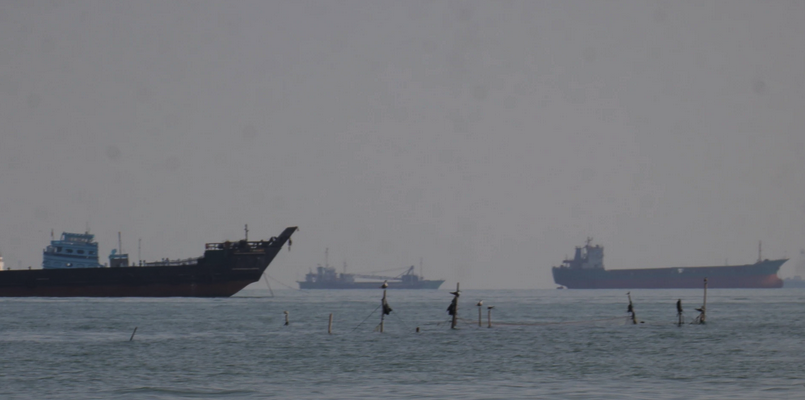
Project Freedom launches Monday to guide stranded ships from Iran-controlled Strait of Hormuz amid attacks. On Monday, the U.S. will start Project Freedom to help ships stuck in the Strait of Hormuz, which is controlled by Iran. Just a few hours after two ships near the strait reported being attacked, President Donald Trump announced the operation on Sunday. Trump didn’t give many details about how the operation would work, but he called it a humanitarian gesture.
Key facts about Project Freedom
- Launch: Monday morning in the Middle East.
- Forces involved: Guided-missile destroyers, 100+ aircraft, 15,000 U.S. service members.
- Goal: Guide hundreds of stranded ships and ~20,000 seafarers out of the Iran-controlled Strait of Hormuz.
- Warning from President Trump: Any interference “will have to be dealt with forcefully.”
- Attacks reported Sunday: A cargo ship hit by small craft; a tanker struck by unknown projectiles (no injuries). First attacks since April 22.
- Iran’s response: Denounced as ceasefire violation; state media called Trump’s announcement “delirium.”
It is meant to help hundreds of ships and about 20,000 sailors who have been stuck in the Persian Gulf since the war started on February 28. “They are victims of circumstance,” Trump said on social media.
He went on to say that the Iran war has hurt “neutral and innocent” countries. Trump said that the operation would start in the Middle East on Monday morning. He also said that his representatives are talking to Iran about something that could be “very good for everyone.”
Iran quickly called the move a violation of the ceasefire, though. Ebrahim Azizi, who is in charge of Iran’s parliament’s national security commission, said on X that any interference in the strait would be seen as breaking the fragile three-week truce.
What Project Freedom involves and the attacks that preceded it
Project Freedom will have guided-missile destroyers, more than 100 planes, and 15,000 service members, according to U.S. Central Command. The Pentagon didn’t say right away how they would be used.
Iran 14 point proposal vs. US red line – who will blink first?
After a stressful Sunday, the news came out. The British military’s United Kingdom Maritime Trade Operations center says that earlier that day, several small boats attacked a cargo ship near the Strait of Hormuz.
Around 11:40 p.m. on Sunday, a second ship, a tanker off the coast of Fujairah, United Arab Emirates, said it was hit by “unknown projectiles.” There were no injuries reported.
These were the first attacks in the area since April 22. The attacks showed how dangerous President Trump’s new plan will be. There have been Iranian patrol boats, some of which are small and hard to see.
Last month, Trump told the U.S. military to “shoot and kill” small Iranian boats that lay mines in the strait. Iran said that the attack on the cargo ship didn’t happen and that it was only stopped for a document check.
Iran’s position and diplomacy alongside Project Freedom
While Project Freedom gets ready to launch, diplomatic work goes on. According to Esmail Baghaei, a spokesman for Iran’s Foreign Ministry, Tehran is looking over the U.S. response to Iran’s most recent 14-point proposal to end the war. Baghaei, on the other hand, made it clear that “At this stage, we have no nuclear negotiations.”
According to the semi-official news agencies Nour News and Tasnim, Iran wants the U.S. to lift sanctions, stop blocking Iranian ports with its navy, pull its troops out of the region, and stop all fighting, including Israel’s operations in Lebanon.
On Saturday, President Trump said he was looking over the proposal but didn’t think it would lead to a deal. At the same time, Pakistan’s prime minister, foreign minister, and army chief are still pushing for direct talks between the U.S. and Iran.
Last month, Pakistan held face-to-face meetings. Ali Nikzad, Iran’s deputy parliament speaker, said on the ground on Sunday that Tehran “will not back down from our position on the Strait of Hormuz, and it will not go back to its prewar state.”
Since April 13, the U.S. naval blockade has turned away 49 commercial ships. Scott Bessent, the U.S. Treasury Secretary, told Fox News that Iran has only made “less than $1.3 million in tolls,” which is a small amount compared to what it used to make in oil sales every day.
Bessent said that Iran’s oil storage is filling up quickly, which means that it may have to shut down wells within the next week.
📊 Project Freedom at a glance – key numbers & status
Source: U.S. Central Command, Treasury Secretary Bessent, British military monitor


1 Comment