
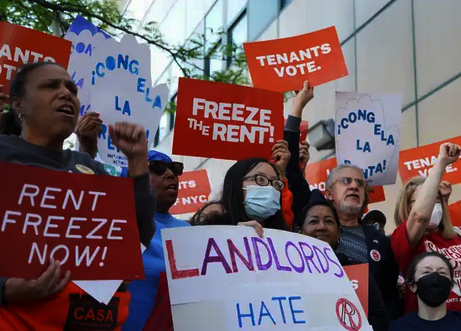
NYC rent freeze: Thursday vote on 0% increase for 1M rent-stabilized apartments. Mamdani’s promise tested. This Thursday is a very important day for the NYC rent freeze. The Rent Guidelines Board, which sets the rules for rents in almost a million rent-stabilized apartments, will cast its first preliminary vote since Mayor Zohran Mamdani took office. The board should be able to agree on ranges for possible rent increases for leases of one year and two years. If the panel is willing to support a freeze, the ranges that were approved at the meeting on Thursday night should start at 0 percent.
📋 Key facts about the NYC rent freeze debate
- Preliminary vote: Thursday evening – board expected to set ranges starting at 0% if freeze is considered.
- Final vote: June 25 – board will approve either increase or freeze after analyzing economic data.
- Mayor’s role: Zohran Mamdani appointed majority of 9 board members, making freeze more likely. Board is supposed to operate independently.
- Affordability crisis: Median asking rent $4,120 (April 2026) vs. $2,800 (April 2019) – worst housing shortage in nearly 60 years.
- Last year’s increase: 3% on one‑year leases, 4.5% on two‑year leases.
- Landlord warning: Ann Korchak (Small Property Owners of NY) says freeze would “defund rent‑stabilized housing.”
- Tenant demand: Rent Justice Coalition calls for rent reduction, not freeze – “landlords sitting on mountains of profits.”
- Net operating income (2023–2024): Up >6% citywide; up in every borough except Bronx (slight dip).
- Rent stabilization basics: 40% of all rentals are rent‑stabilized. Median stabilized studio $1,360; market‑rate studio $2,000. Median tenant income $60k vs. $90.8k market‑rate.
- Higher‑income tenants: 7% of stabilized households earn $150k–$200k.
- New units: Nearly 15,000 rent‑stabilized units added in 2024 – median rent >$3,100 (tax break exchanges).
- Bronx divergence: Net operating income rose 1.5% in buildings built ≥1974, but fell 0.8% in older buildings.
The board will officially approve either a rent increase or a freeze when it votes again on June 25. Before that, it will look at the economics of rent-stabilized buildings, renter incomes, wage data, inflation, and the housing supply. The city is in one of its worst affordability crises ever, with the worst housing shortage in almost 60 years.
NYC free buses: Council vs. mayor cost debate
In April 2026, the average asking rent for a new lease was about 4,120, up from 2,800 in April 2019. Last year, the board let rents go up by 3% for one-year leases and 4.5% for two-year leases.
Who decides the NYC rent freeze? Mayor’s appointees face independence test
Economic data behind the NYC rent freeze debate
Net operating income (2023–2024): Rose >6% citywide. Increased in every borough except the Bronx (slight dip).
Rent stabilization coverage: 40% of all rental apartments in NYC are rent stabilized.
Median rents – stabilized vs. market‑rate: Studio: $1,360 vs. $2,000; Two‑bedroom: $1,530 vs. $2,200.
Median household income: Stabilized tenants ~$60,000; Market‑rate households ~$90,800 (2023 survey).
Higher‑income tenants: 7% of stabilized households earn $150k–$200k (Citizens Budget Commission).
New stabilized units: Nearly 15,000 added in 2024 – median rent >$3,100 (in exchange for tax breaks).
Bronx divergence (2023–2024): Net operating income +1.5% in buildings built ≥1974; –0.8% in older buildings.
The mayor chooses all nine members of the Rent Guidelines Board. Mr. Mamdani chose most of the current members, which makes it more likely that the panel will support a freeze on NYC rents. The board, on the other hand, is supposed to work on its own, without the mayor’s help. Mr. Mamdani said in February, “I hope they will think about all the things that rent-stabilized tenants in the city are going through and make the right choice.” Landlords are fighting back.
Ann Korchak, president of the Small Property Owners of New York, said that if members “give in to the politics of a rent freeze or small rent increase,” they will be “following a path of defunding rent-stabilized housing.” Tenant groups, on the other hand, want even more: a rent cut.
The Rent Justice Coalition, which is made up of many tenant groups, wrote to the board: “Landlords have been making a lot of money for a long time while our buildings fall apart.” When landlords raise our rent, they use that money to buy new buildings and line their own pockets, not fix our homes.
The economics of an NYC rent freeze – landlords, tenants, and the Bronx split
The board’s research shows that net operating income, which is a measure of a building’s financial health (rent revenue minus costs like insurance), went up in every borough except the Bronx, where it went down slightly. It went up by more than 6% across the city. Rent stabilization was put in place in the middle of the 20th century to protect people from big rent hikes. Rent stabilization affects 40% of all rental apartments in the city today, housing a wide range of New Yorkers. A median rent-stabilized studio costs about $1,360, while a two-bedroom costs about $1,530. On the other hand, studios at market rates cost $2,000, and two-bedroom apartments cost $2,000 and $2,200.
Most rent-stabilized tenants have lower or middle incomes. The median household income is about $60,000, which is less than the $90,800 that market-rate households make. But about 7% of rent-stabilized households, which is tens of thousands of people, make between $150,000 and $200,000. Many new, expensive apartments are kept rent-stabilized because developers get tax breaks on the property.
In 2024, the city added almost 15,000 rent-stabilized units, with a median rent of more than $3,100. The finances of these newer buildings are very different from those of older, less expensive ones. For example, older buildings tend to have lower net operating incomes. The Bronx is where this split is most clear. Buildings built in or after 1974 saw a 1.5% increase in net operating income, while buildings built before 1974 saw a 0.8% decrease.
As the preliminary vote on Thursday gets closer, the NYC rent freeze is still a hot topic. It weighs tenant relief against landlord costs and new luxury units against old housing stock.
What’s next for the NYC rent freeze?
Thursday: Preliminary vote on increase ranges (expected to start at 0%). June 25: Final vote on freeze or increase. The board will weigh economic data, landlord arguments, and tenant demands. Mayor Mamdani’s majority appointees could make a freeze more likely, but independence is supposed to guide their decision.