
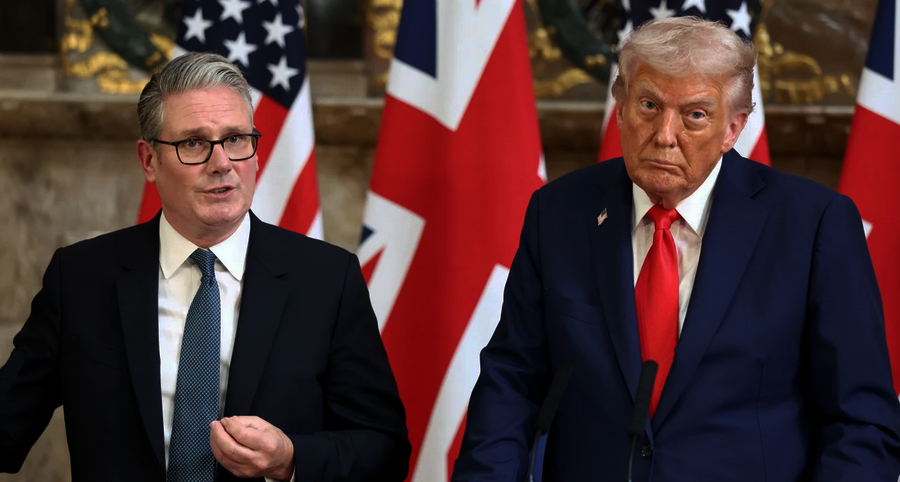
UK rejects US support for Iran blockade as Prime Minister Keir Starmer says Britain will not be dragged into the conflict. This article explains how the UK distances itself from the Iran blockade while France proposes a multinational defensive mission with Emmanuel Macron leading diplomatic efforts.
The UK has made it clear that it will not back the US’s blockade of Iranian ports. This shows that Western allies are becoming more divided over the conflict in Iran. On Monday, British Prime Minister Keir Starmer said that the UK would not be “dragged in” to the Iran war. This was a clear break from Washington’s military strategy.
His comments come at a time when tensions are rising after the U.S. announced a blockade of Iranian maritime routes. This has raised worries about the security of global energy supplies and the stability of the region.
French President Emmanuel Macron also said that France and the UK will co-host an international conference in the next few days. The goal of the meeting is to restore free passage through the Strait of Hormuz, which is one of the most important oil and gas shipping routes in the world.
The UK’s stance on the blockade of Iran and military action
Prime Minister Keir Starmer was clear that the UK would not be involved in the US military strategy. He told BBC Radio 5 Live:
“We’re not in favor of the blockade, and all of the marshalling—diplomatically, politically, and in terms of capability—we do have mine-sweeping capability. I won’t go into operational matters, but we do have that capability. From our point of view, all of that is focused on getting the strait fully open.”
Starmer stressed that the UK’s top priority is to keep shipping lanes open around the world, not to make things worse. He went on to say:
“We’ve been working together with other countries to keep the strait open, not closed. This is what I talked about with the Gulf states last week.”
A lot of the world’s oil flows through the Strait of Hormuz, which is a very important shipping route. If this route is blocked, it can have immediate effects on trade, energy prices, and the economy around the world.
Iran Blockade Update: Rising Oil Prices and Political Pressure
Starmer also said that the conflict is already affecting British people by making energy costs go up. He did, however, say that the ongoing tensions in the area, especially over Iran’s control of shipping routes, are to blame for the crisis.
The Prime Minister said, “We, the United Kingdom, were very clear that we weren’t going to get dragged into this war, and we’re not, but we have been involved in defensive action.”
France Suggests a Multinational “Defensive” Maritime Mission
The UK is moving away from the U.S. blockade, but France is taking a different diplomatic approach. Emmanuel Macron, the president of France, has suggested an international conference to set up a “peaceful multinational” mission to keep navigation safe in the Strait of Hormuz.
Macron said that France and the UK would work with other countries that wanted to to set up a strictly defensive presence in the area. But he hasn’t clearly said that France won’t help the U.S. blockade in any way.
Macron said in a public statement that the goal of the initiative would be to make maritime travel safe again and keep military forces from directly fighting each other.
He said that the proposed effort would be “a peaceful multinational” and “strictly defensive” mission that would work on its own, separate from the war between the US and Iran.
International Community Hesitant to Support U.S. Push for Blockade
After U.S. President Donald Trump said that a blockade of Iranian maritime traffic would start at 10 a.m. Eastern Time on Monday, there was a diplomatic split. The move came after Washington and Tehran couldn’t agree on anything over the weekend that would have ended the larger conflict in the Middle East.
On Sunday, President Trump said:
“We have a blockade going into effect at 10 tomorrow,” they said, adding that “other countries are working to make sure Iran can’t sell oil.”
The White House has not said which countries will help enforce the blockade, though. European and Gulf states have mostly been unwilling to get involved because they think the conflict is very dangerous and could get worse.
Germany has also made it clear that it won’t be part of the blockade. Sources in the Berlin government said that Trump’s remarks were “a vague statement that is not based on any new facts.” Officials said again that Germany would not send troops to fight in Iran.
People all over the world are worried about energy and security risks.
The disagreement shows that people are more worried about global energy security. The Strait of Hormuz is one of the most important oil trade routes in the world. Any problems there can cause fuel prices to rise sharply and the economy to become unstable around the world.
Prime Minister Keir Starmer said that the UK is still focused on keeping the strait open and stopping things from getting worse. France, on the other hand, is trying to put together a coalition for a defensive naval presence, but Germany and other European countries are refusing to send troops.
The lack of a unified Western response shows how complicated the Iran conflict is and how hard it is to find a balance between military pressure and diplomatic restraint as the situation changes.
The U.S. blockade plan has made things worse between allies for now, and it makes people wonder how far other countries are willing to go to support Washington’s plan.
1 Comment