
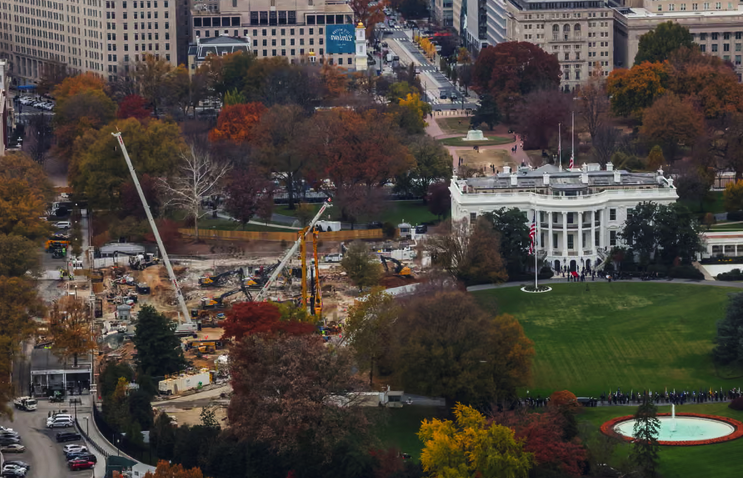
A big legal change has made it possible for the White House ballroom construction project to go ahead. A three-judge panel from the U.S. Court of Appeals for Washington, D.C., said on Friday that the Trump administration can keep building the $400 million ballroom where the old East Wing used to be. This choice has brought the ongoing discussion about the building of the White House ballroom and whether it follows legal and constitutional rules back into the spotlight.
The ruling puts a stop to an earlier court order that had limited most of the work on the White House ballroom construction that was above ground. The appeals court gave judges more time to look over the case in detail by issuing what is called a “administrative stay.” The court made it clear that this step does not mean that the White House ballroom construction project is legal or not.
White House ballroom construction : a legal battle and court decisions
Preservation groups have strongly opposed the construction of the White House ballroom. The National Trust for Historic Preservation sued to find out if President Donald Trump had the right to tear down the East Wing and start building without getting permission from Congress.
In March, U.S. District Judge Richard Leon ruled that the administration had to stop most of the White House ballroom construction because it did not have permission from Congress. This choice made things very difficult for the project.
But the situation quickly got more complicated. The appeals court later told Judge Richard Leon to think about his decision again, especially when it comes to national security issues. After that, the judge let some parts of the White House ballroom construction go on, specifically work on security features that were happening underground.
Judge Richard Leon said that the administration could go ahead with building bunkers and other structures below ground, as long as they don’t make the ballroom’s size and scale above ground permanent. This condition was meant to stop work on the visible parts of the White House ballroom construction from moving forward until legal issues are settled.
Concerns about national security during the White House ballroom construction
One of the main reasons the Trump administration gave for continuing the construction of the White House ballroom is national security. Lawyers for the government said that stopping the project could be very dangerous.
They said that stopping the construction of the White House ballroom would “threaten grave national-security harms to the White House, the president and his family, and the president’s staff.” The government says that the project includes important security improvements that will help protect against new threats.
These worries were a big reason why the appeals court let the White House ballroom construction go on, at least for now. The court made it clear that it needed more time to fully look over the emergency request before making a final decision.
The decision of the appeals court about the White House ballroom construction
The appeals court’s most recent order is all about keeping things the same while the legal arguments go on. The judges gave a temporary stay so that the construction of the White House ballroom would not stop completely while the review process was going on.
Is the Virginia Redistricting Referendum About to Flip Congress Power?
The court said in its statement that the stay was granted to give “the court enough time to think about the emergency motion for a stay pending appeal.” The judges also made it clear that this action “should not be seen in any way as a decision on the merits of that motion.”
This means that the construction of the White House ballroom can go on for now, but the case’s final outcome is still up in the air. Future decisions could either let the project go ahead as planned or add new rules.
Funding and business support for the White House ballroom construction
How the White House ballroom construction is being paid for is another important part of it. Donald Trump has said many times that the project is not using taxpayer money; instead, it is being paid for by private donors and big businesses.
Meta, Apple, Amazon, Lockheed Martin, Microsoft, Palantir, Google, and Comcast are some of the companies that are said to be helping build the White House ballroom.
This money shows how big and ambitious the White House ballroom construction is. It is part of a larger plan by the president to change parts of the capital.
White House ballroom construction : a bigger plan for Washington
Building the White House ballroom is just one part of a bigger project. President Donald Trump has a bigger plan to make a lasting physical change in Washington, D.C. Other ideas are to build a 250-foot arch and spend several years fixing up the John F. Kennedy Center for the Performing Arts.
Supporters say that these projects will make important landmarks more modern and raise the country’s status. Some people, on the other hand, wonder if these kinds of big projects should go ahead without more oversight and approval from Congress.
The White House ballroom construction is still a symbol of the larger debate over executive power, national security, and preserving history, even though the legal battle is still going on.


1 Comment